ANUNNAKIRISMO IL SIMBOLO ASSOLUTO
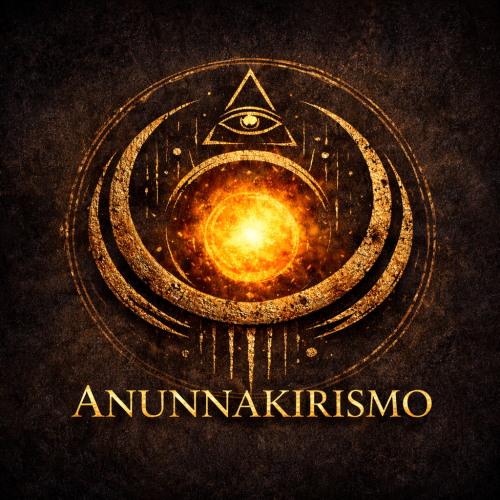
Nel percorso evolutivo dell’Anunnakirismo, movimento artistico fondato dal Maestro Giuseppe Grieco EditorDreams, questa opera rappresenta un momento di estrema sintesi: una riduzione dell’immagine alla sua essenza più potente, dove ogni elemento diventa segno e ogni segno diventa concetto. La composizione si struttura attorno a un nucleo centrale incandescente, una sfera luminosa che sembra pulsare come un cuore cosmico. Attorno ad essa, una costruzione precisa: un arco circolare, una forma avvolgente, e sopra, un triangolo contenente un occhio. Non siamo di fronte a una semplice immagine, ma a un sistema iconografico stratificato.
L’occhio inscritto nel triangolo richiama immediatamente una lunga tradizione simbolica, attraversando epoche e culture. Tuttavia, in questo contesto, esso non si limita a evocare il controllo o la sorveglianza, ma si trasforma in metafora della coscienza attiva. Non è uno sguardo che osserva dall’esterno, ma una presenza che suggerisce consapevolezza interna, percezione espansa.
L’Anunnakirismo, in questa forma, sembra proporre una ridefinizione della visione stessa: non più atto passivo, ma processo dinamico. Al centro della composizione, la sfera luminosa domina la scena con una forza quasi fisica. La sua resa materica incandescente, instabile, vibrante suggerisce un’energia non ancora completamente formata, una origine in atto.
Essa non è contenuta, ma trattenuta. Non è stabile, ma in continua trasformazione. Questo la rende il vero fulcro dell’opera: non solo elemento visivo, ma principio generativo. L’arco che avvolge la sfera introduce un ulteriore livello di lettura. Il cerchio, simbolo universale di totalità e continuità qui assume una funzione duplice: da un lato, contiene e delimita dall’altro, protegge e canalizza. Questa ambivalenza riflette una tensione centrale nell’opera: l’energia deve essere libera per esistere, ma strutturata per manifestarsi. Il fondo scuro, fortemente materico, gioca un ruolo fondamentale. Non è un semplice sfondo, ma una superficie viva, quasi archeologica, che suggerisce stratificazione, tempo, sedimentazione.
Su questa base, il segno dorato emerge con forza, creando un contrasto netto tra profondità e rivelazione. L’oro, ancora una volta, non è decorazione, ma linguaggio: indica valore, ma anche trasformazione. La presenza della parola ANUNNAKIRISMO nella parte inferiore dell’opera stabilisce un ancoraggio chiaro. Dopo la complessità simbolica della parte superiore, il testo introduce una definizione, una dichiarazione. Non è subordinato all’immagine, ma la completa. Funziona come sigillo, come nome che dà forma a un sistema visivo e concettuale più ampio.
Con questa opera, l’Anunnakirismo si avvicina a una dimensione ancora più radicale: quella della costruzione di un alfabeto simbolico autonomo. Non si tratta più di rappresentare visioni, ma di creare segni che possano essere letti, riconosciuti, reinterpretati.
In un’epoca dominata dunque dall’eccesso di immagini, questa tensione verso la sintesi appare come un gesto significativo: ridurre per intensificare, semplificare per amplificare.
Ed è proprio in questa essenzialità carica di significato che l’Anunnakirismo trova, in maniera sistemica, una delle sue espressioni più mature.
ANUNNAKIRISM THE ULTIMATE SYMBOL
In the evolutionary journey of Anunnakirism, an artistic movement founded by Master Giuseppe Grieco EditorDreams, this work represents a moment of extreme synthesis: a reduction of the image to its most powerful essence, where every element becomes a sign and every sign becomes a concept. The composition is structured around an incandescent central core, a luminous sphere that seems to pulsate like a cosmic heart. Surrounding it is a precise construction: a circular arch, an enveloping form, and above it, a triangle containing an eye. We are not looking at a simple image, but at a layered iconographic system.
The eye inscribed within the triangle immediately evokes a long symbolic tradition, spanning eras and cultures. However, in this context, it does not merely evoke control or surveillance, but transforms into a metaphor for active consciousness. It is not a gaze observing from the outside, but a presence suggesting inner awareness, expanded perception. Anunnakirism, in this form, seems to propose a redefinition of vision itself: no longer a passive act, but a dynamic process. At the center of the composition, the luminous sphere dominates the scene with an almost physical force. Its incandescent, unstable, vibrant rendering suggests an energy not yet fully formed, an origin in the making.
It is not contained, but held in place. It is not stable, but in constant transformation. This makes it the true focal point of the work: not merely a visual element, but a generative principle. The arch that envelops the sphere introduces a further layer of interpretation. The circle, a universal symbol of wholeness and continuity, takes on a dual function here: on the one hand, it contains and delimits; on the other, it protects and channels. This ambivalence reflects a central tension in the work: energy must be free to exist, yet structured to manifest itself. The dark, highly textured background plays a fundamental role. It is not a mere backdrop, but a living, almost archaeological surface that suggests stratification, time, and sedimentation.
On this basis, the golden symbol emerges powerfully, creating a sharp contrast between depth and revelation. Gold, once again, is not decoration, but language: it signifies value, but also transformation. The presence of the word ANUNNAKIRISMO at the bottom of the work establishes a clear anchor. Following the symbolic complexity of the upper part, the text introduces a definition, a declaration. It is not subordinate to the image, but completes it. It functions as a seal, as a name that gives form to a broader visual and conceptual system.
With this work, Anunnakirismo approaches an even more radical dimension: that of constructing an autonomous symbolic alphabet. It is no longer a matter of representing visions, but of creating signs that can be read, recognized, and reinterpreted.
In an era dominated by an excess of images, this drive toward synthesis appears as a significant gesture: reducing to intensify, simplifying to amplify.
And it is precisely in this meaningful essentiality that Anunnakirism finds, in a systemic way, one of its most mature expressions.
Hai bisogno di informazioni?
Vuoi chiedere maggiori informazioni? Lasciami un messaggio, risponderò al più presto