ANUNNAKIRISMO LA DEA MADRE
ANUNNAKIRISMO LA DEA MADRE
Nel cuore dell’immaginario ancestrale dell’umanità vive una figura che attraversa epoche, civiltà e simbolismi: la Dea Madre. Non è soltanto un archetipo, ma una memoria collettiva. Non è soltanto mito, ma struttura interiore. Nell’orizzonte dell’Anunnakirismo, la Dea Madre non rappresenta semplicemente il principio femminile: è la matrice cosmica da cui scaturisce la coscienza.
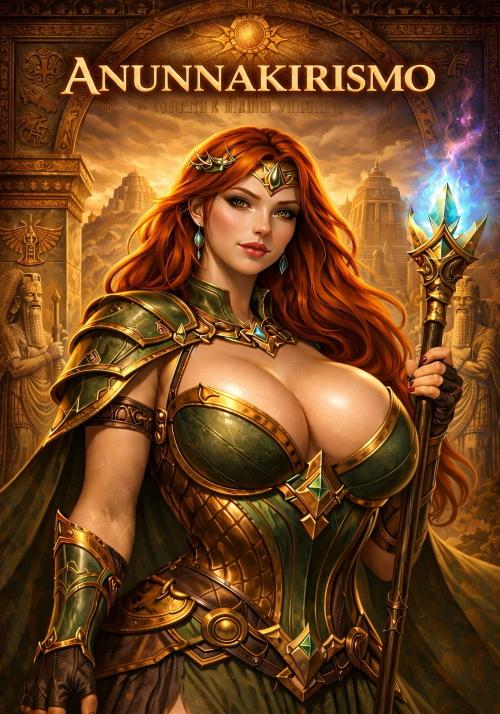
L’immagine che accompagna questo titolo raffigura una figura regale, guerriera e al tempo stesso generatrice. I capelli rosso fiamma evocano la potenza primordiale della terra e del sangue; l’armatura verde e oro richiama la fusione tra natura e divinità; lo scettro acceso di energia azzurra è il simbolo della conoscenza custodita, della forza che non distrugge ma ordina.
Nel paradigma dell’Anunnakirismo, la Dea assume le vesti di Origine e Custode delle umane profondità biologiche. Essa non è subordinata né complementare a un principio maschile ma ne il è fondamento. È l’intelligenza che genera la forma, la volontà che plasma la materia, l’energia che protegge la creazione.
Le civiltà antiche dalla Mesopotamia al Mediterraneo arcaico hanno tramandato immagini di divinità femminili legate alla fertilità, alla guerra, alla sapienza e alla regalità. Tuttavia, l’Anunnakirismo compie un passaggio ulteriore: non si limita alla lettura storica o mitologica, ma ne propone una visione iniziatica.
La Dea Madre diventa così Potenza generativa universale, Principio ordinatore del caos,
Archetipo della sovranità interiore e Simbolo ancestrale di riconnessione con la memoria originaria dell’essere.
Essa non è affatto una figura remota ma è una forza interiore da risvegliare: E’ la Guerriera della Luce Verde.
L’iconografia scelta infatti non è casuale. La veste verde rappresenta la vita, la rigenerazione, la ciclicità naturale. L’oro richiama la coscienza solare, l’illuminazione. Lo scettro acceso indica che il potere autentico non è dominio, ma padronanza energetica.
La Dea Madre nell’Anunnakirismo è guerriera non perché combatta per distruggere, ma perché difende l’ordine cosmico. È la forza che ristabilisce equilibrio quando l’umanità si allontana dalla propria origine.
In questo senso, il femminile non è debolezza, ma fondazione. Non è passività, ma vera e propria potenza creatrice.
L’Anunnakirismo propone il risveglio delle Coscienze attraverso un percorso interiore fatto di virtù e condsapevolezza.
La Dea Madre è il simbolo del recupero della dignità originaria, della riconnessione con la Terra come entità viva, di equilibrio tra potere e compassione, di superamento della frammentazione moderna attraverso una più accurata analisi del gusto e del bello.
Viviamo in un’epoca in cui il principio materno è stato spesso marginalizzato o ridotto a funzione biologica.
L’archetipo della Dea Madre invita invece a riscoprire la maternità come coscienza generativa: creare idee, visioni, armonia per risvegliare il sacro fuoco racchiuso all’interno di ciascuno di noi.
L’Anunnakirismo interpreta dunque la Dea Madre come codice dormiente nell’inconscio collettivo. Non si tratta di tornare al passato, ma di integrare ciò che è stato dimenticato.
La figura regale che osserva l’orizzonte con il castello lontano e il cielo incendiato dal tramonto rappresenta una soglia. È il momento in cui l’umanità può scegliere se restare nella dimenticanza o riattivare la memoria originaria. La Dea Madre non impone: attende. E forse l’Anunnakirismo come Movimento Artistico e Principio Filosofico nasce proprio da questa attesa.
ANUNNAKIRISM THE MOTHER GODDESS
At the heart of humanity’s ancestral imagination lives a figure that spans eras, civilizations, and symbolism: the Mother Goddess. She is not only an archetype, but a collective memory. She is not only myth, but an inner structure. In Anunnakirism, the Mother Goddess does not simply represent the feminine principle: she is the cosmic matrix from which consciousness springs.
The image accompanying this title depicts a regal figure, both warrior and creator. Her flaming red hair evokes the primordial power of earth and blood; her green and gold armor recalls the fusion between nature and divinity; her scepter, ablaze with blue energy, is the symbol of guarded knowledge, of the force that does not destroy but orders.
In the Anunnakism paradigm, the Goddess takes on the role of Origin and Guardian of human biological depths. She is neither subordinate nor complementary to a masculine principle but is its foundation. She is the intelligence that generates form, the will that shapes matter, the energy that protects creation.
Ancient civilizations from Mesopotamia to the archaic Mediterranean have handed down images of female deities linked to fertility, war, wisdom, and royalty. However, Anunnakirism goes a step further: it is not limited to historical or mythological interpretation, but proposes an initiatory vision.
The Mother Goddess thus becomes a Universal Generative Power, the organizing principle of chaos,
the archetype of inner sovereignty, and an ancestral symbol of reconnection with the original memory of being.
She is not at all a remote figure but an inner force to be awakened: she is the Warrior of Green Light.
The iconography chosen is not random. The green robe represents life, regeneration, and natural cyclicality. Gold recalls solar consciousness and enlightenment. The lit scepter indicates that authentic power is not domination, but energetic mastery.
The Mother Goddess in Anunnakirism is a warrior not because she fights to destroy, but because she defends the cosmic order. She is the force that restores balance when humanity strays from its origins.
In this sense, the feminine is not weakness, but foundation. It is not passivity, but true creative power.
Anunnakirism proposes the awakening of Consciousness through an inner journey of virtue and awareness.
The Mother Goddess is the symbol of the recovery of original dignity, of reconnection with the Earth as a living entity, of balance between power and compassion, of overcoming modern fragmentation through a more accurate analysis of taste and beauty.
We live in an age in which the maternal principle has often been marginalized or reduced to a biological function.
The archetype of the Mother Goddess, on the other hand, invites us to rediscover motherhood as generative consciousness: creating ideas, visions, and harmony to reawaken the sacred fire within each of us.
Anunnakirism therefore interprets the Mother Goddess as a dormant code in the collective unconscious. It is not a question of returning to the past, but of integrating what has been forgotten.
The regal figure observing the horizon with the distant castle and the sky ablaze with sunset represents a threshold. It is the moment when humanity can choose whether to remain in oblivion or reactivate its original memory. The Mother Goddess does not impose: she waits. And perhaps Anunnakirism as an Artistic Movement and Philosophical Principle arises precisely from this waiting.
Hai bisogno di informazioni?
Vuoi chiedere maggiori informazioni? Lasciami un messaggio, risponderò al più presto