ANUNNAKIRISMO MARCHIO DI IDENTITA’
ANUNNAKIRISMO MARCHIO DI IDENTITA’
Nel contesto dell’arte contemporanea, sempre più orientata verso la costruzione di universi simbolici autonomi, l’Anunnakirismo, movimento artistico fondato dal Maestro Giuseppe Grieco in arte EditorDreams, si manifesta non solo come linguaggio visivo, ma come sistema identitario coerente. L’opera qui analizzata segna un passaggio cruciale: dalla narrazione figurativa alla codificazione del simbolo.
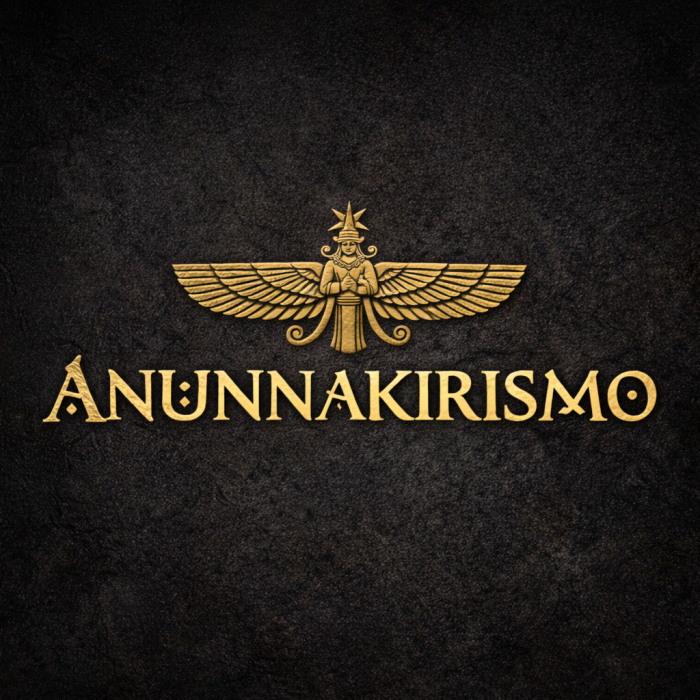
L’immagine si presenta come un emblema: fondo scuro, materico, quasi litico, sul quale emerge una composizione dorata di straordinaria precisione formale. Al centro, una figura alata stilizzata richiama immediatamente iconografie ancestrali della Mesopotamia antica, ma viene ridotta all’essenziale, trasformata in segno archetipico. Sotto di essa, la parola ANUNNAKIRISMO non è semplice titolo, ma dichiarazione. È “Marchio di Identità”, è affermazione di un sistema visivo che ambisce a essere riconoscibile, replicabile, trasmissibile.
Se nelle opere precedenti l’Anunnakirismo si esprimeva attraverso immagini complesse, ricche di narrazione e luce, qui assistiamo a una riduzione consapevole. Non si tratta di una semplificazione, ma di una distillazione. Il mito non viene più raccontato: viene compresso in un simbolo.
La figura alata, con la sua simmetria rigorosa e la frontalità ieratica, non rappresenta un’entità specifica, ma un principio. È il risultato di un processo di astrazione che porta l’immagine a diventare linguaggio, quasi al confine con il design, ma senza perdere la propria densità concettuale.
La scelta cromatica è tutt’altro che decorativa. Il contrasto tra il fondo scuro e la superficie dorata costruisce una tensione visiva che richiama immediatamente il rapporto tra conoscenza e mistero, tra rivelazione e occultamento. L’oro, tradizionalmente associato al sacro, al potere e all’incorruttibilità, qui assume una doppia funzione: da un lato, eleva il simbolo a icona
dall’altro, lo separa dal contesto, rendendolo quasi sospeso, fuori dal tempo. Il fondo, invece, con la sua texture ruvida e profonda, suggerisce materia primordiale, origine, terreno non ancora completamente rivelato.
La composizione è costruita su una simmetria perfetta, elemento che nella storia dell’arte ha sempre veicolato concetti di ordine, controllo e trascendenza. Qui la simmetria non è solo estetica, ma strutturale: comunica stabilità, centralità, inevitabilità. Il simbolo non fluttua, non si muove, non racconta. Esiste. Questa staticità lo avvicina al linguaggio dei sigilli per attivare un immaginario.
Uno degli aspetti più interessanti di questa opera è la sua capacità di posizionarsi in una zona ibrida tra arte e branding. Il termine Anunnakirismo, reso in una tipografia solida e incisiva, diventa qui un vero e proprio Marchio Culturale Artistico.
Come costruzione di un’identità riconoscibile, capace di generare appartenenza e continuità. In un’epoca in cui l’artista non è più soltanto autore, ma anche costruttore di universi narrativi, questa operazione appare perfettamente in linea con le dinamiche contemporanee. Ed è proprio in questa trasformazione dalla visione al segno, dal racconto all’identità che si rivela la maturità del progetto: la capacità di esistere non solo come opera, ma come sistema.
ANUNNAKIRISM A TRADEMARK OF IDENTITY
In the context of contemporary art, which is increasingly oriented toward the construction of autonomous symbolic universes, Anunnakirism, an artistic movement founded by Master Giuseppe Grieco, known by his pseudonym EditorDreams, manifests itself not only as a visual language but as a coherent system of identity. The work analyzed here marks a crucial transition: from figurative narration to the codification of the symbol.
The image presents itself as an emblem: a dark, textured, almost lithic background from which emerges a golden composition of extraordinary formal precision. At the center, a stylized winged figure immediately evokes ancestral iconography from ancient Mesopotamia, yet it is reduced to the essential, transformed into an archetypal sign. Beneath it, the word ANUNNAKIRISMO is not merely a title, but a declaration. It is a Mark of Identity, an affirmation of a visual system that aspires to be recognizable, replicable, and transmissible.
While in previous works Anunnakirism was expressed through complex images, rich in narrative and light, here we witness a deliberate reduction. This is not a simplification, but a distillation. The myth is no longer told: it is compressed into a symbol. The winged figure, with its rigorous symmetry and solemn frontal pose, does not represent a specific entity, but a principle. It is the result of a process of abstraction that transforms the image into language, almost bordering on design, yet without losing its conceptual depth.
The choice of color is anything but decorative. The contrast between the dark background and the golden surface creates a visual tension that immediately evokes the relationship between knowledge and mystery, between revelation and concealment. Gold, traditionally associated with the sacred, power, and incorruptibility, takes on a dual function here: on the one hand, it elevates the symbol to an icon; on the other, it separates it from its context, rendering it almost suspended, outside of time.
The background, on the other hand, with its rough and deep texture, suggests primordial matter, origin, terrain not yet fully revealed.
The composition is built on perfect symmetry, an element that, throughout art history, has always conveyed concepts of order, control, and transcendence. Here, symmetry is not merely aesthetic but structural: it conveys stability, centrality, and inevitability. The symbol does not waver, does not move, does not narrate. It simply exists. This stillness brings it closer to the language of seals, serving to evoke a visual imagery.
One of the most interesting aspects of this work is its ability to position itself in a hybrid zone between art and branding. The term Anunnakirism, rendered in a solid and incisive typography, becomes here a true Cultural Brand. As the construction of a recognizable identity, capable of generating a sense of belonging and continuity. In an era where the artist is no longer merely an author but also a builder of narrative universes, this approach appears perfectly in line with contemporary dynamics. And it is precisely in this transformation from vision to sign, from narrative to identity, that the project’s maturity is revealed: the ability to exist not only as a work but as a system.
Hai bisogno di informazioni?
Vuoi chiedere maggiori informazioni? Lasciami un messaggio, risponderò al più presto