ANUNNAKIRISMO TRA MACCHINA E COSCIENZA
ANUNNAKIRISMO TRA MACCHINA E COSCIENZA
Nel panorama dell’arte contemporanea emergente, l’Anunnakirismo si afferma come una corrente capace di superare i confini tradizionali della rappresentazione, introducendo una visione in cui l’uomo non è più soltanto materia, ma sintesi evoluta tra coscienza, tecnologia e origine divina.
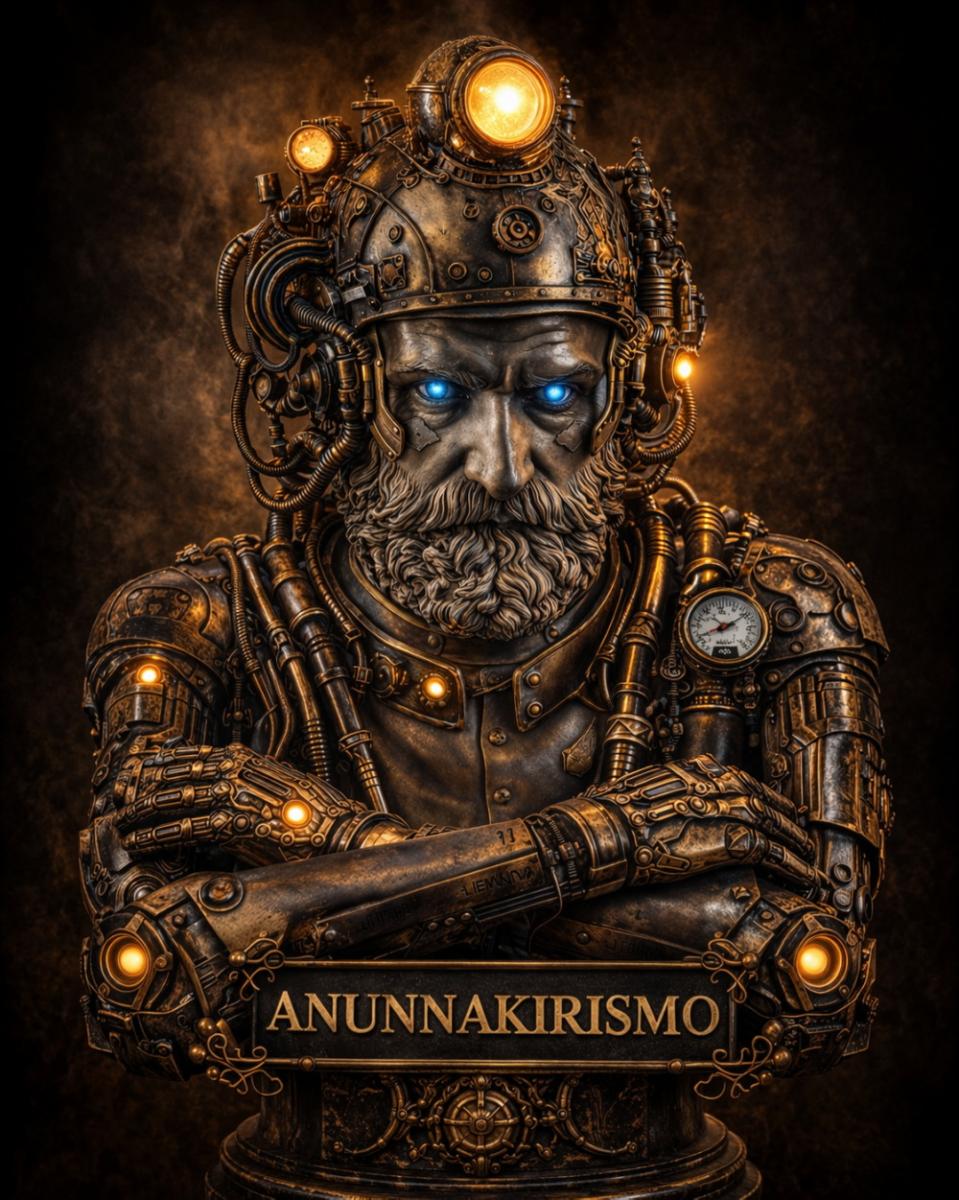
L’opera qui presentata incarna perfettamente questa tensione: un volto antico, segnato dal tempo, che si fonde con strutture meccaniche complesse, dando vita a una figura ibrida, sospesa tra passato e futuro. Non si tratta semplicemente di estetica steampunk o di una suggestione cybernetica, ma di un manifesto visivo: l’essere umano come entità in trasformazione.
Lo sguardo, reso ancora più potente dalla luce artificiale che attraversa entrambi gli occhi, non è umano nel senso tradizionale. È uno “Sguardo Attivato”, risvegliato. Qui l’Anunnakirismo introduce un concetto fondamentale: l’uomo non evolve solo biologicamente, ma si riattiva a livello coscienziale. La barba, i tratti classici, rimandano a una memoria ancestrale, quasi sacerdotale. Ma è proprio su questa base che si innesta la trasformazione: tubi, circuiti, metallo. Non come elementi estranei, bensì come estensione naturale della coscienza. La “Macchina dunque come Simbolo”, non come limite. Infatti nell’Anunnakirismo, la tecnologia non è alienazione, ma linguaggio. Le componenti meccaniche presenti nell’opera non indicano perdita di umanità, ma il contrario: rappresentano il tentativo dell’uomo di ricodificare se stesso. Il casco, i dispositivi, gli innesti non sono strumenti, ma simboli di una nuova fase evolutiva. È il passaggio dall’uomo biologico all’uomo cosciente della propria origine cosmica.
La scritta “ANUNNAKIRISMO”, posta come sigillo alla base dell’opera, non è un semplice titolo. È una dichiarazione. Un vero e proprio “Codice della trasformazione”. Essa sancisce l’appartenenza a una visione artistica e filosofica che interpreta l’esistenza come un sistema aperto, riscrivibile. L’individuo non è più spettatore, ma artefice del proprio diagramma vitale. Questa opera si inserisce in una nuova iconografia, dove: il sacro incontra il tecnologico, l’antico dialoga con il futuro, l’uomo diventa ponte tra dimensioni. L’Anunnakirismo propone quindi una rivoluzione non solo estetica, ma concettuale: l’arte non rappresenta più il mondo, ma lo ri-programma simbolicamente.
In questa figura, potente e immobile, si riflette dunque una verità profonda: l’essere umano è in continua ridefinizione. L’Anunnakirismo, di par suo, non descrive questa trasformazione…la attiva.
ANUNNAKIRISM BETWEEN MACHINE AND CONSCIOUSNESS
Within the emerging contemporary art scene, Anunnakirism has established itself as a movement capable of transcending the traditional boundaries of representation, introducing a vision in which humanity is no longer merely matter, but an evolved synthesis of consciousness, technology and divine origin. The work presented here perfectly embodies this tension: an ancient face, marked by time, which merges with complex mechanical structures, giving rise to a hybrid figure, suspended between past and future. This is not merely a matter of steampunk aesthetics or a cybernetic suggestion, but a visual manifesto: the human being as an entity in transformation.
The gaze, rendered even more powerful by the artificial light passing through both eyes, is not human in the traditional sense. It is an ‘Activated Gaze’, an awakened gaze. Here, Anunnakirism introduces a fundamental concept: man does not evolve merely biologically, but is reactivated on a conscious level. The beard and classical features evoke an ancestral, almost priestly memory. Yet it is precisely upon this foundation that transformation takes root: tubes, circuits, metal. Not as foreign elements, but as a natural extension of consciousness. The ‘Machine, therefore, as a Symbol’, not as a limitation. Indeed, in Anunnakirism, technology is not alienation, but language. The mechanical components present in the work do not indicate a loss of humanity, but the opposite: they represent man’s attempt to recode himself. The helmet, the devices, the implants are not tools, but symbols of a new evolutionary phase. It is the transition from the biological man to the man conscious of his own cosmic origin.
The inscription “ANUNNAKIRISMO”, placed as a seal at the base of the work, is not merely a title. It is a declaration. A veritable “Code of Transformation”. It affirms an affiliation with an artistic and philosophical vision that interprets existence as an open, rewritable system. The individual is no longer a spectator, but the architect of their own life diagram. This work forms part of a new iconography, where: the sacred meets the technological, the ancient converses with the future, and humanity becomes a bridge between dimensions. Anunnakirism thus proposes a revolution that is not merely aesthetic, but conceptual: art no longer represents the world, but symbolically reprogrammes it.
In this figure, powerful and immobile, a profound truth is thus reflected: the human being is in a state of constant redefinition. Anunnakirism, for its part, does not merely describe this transformation… it activates it.
Hai bisogno di informazioni?
Vuoi chiedere maggiori informazioni? Lasciami un messaggio, risponderò al più presto