ANUNNAKIRISMO DUALITA’ ENERGETICA
ANUNNAKIRISMO DUALITA’ ENERGETICA
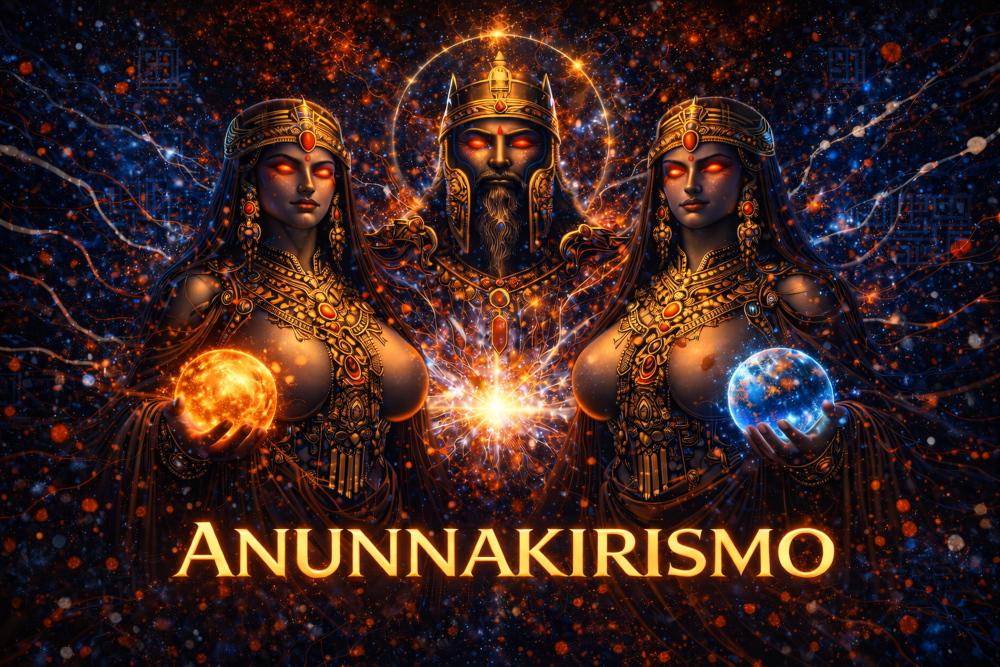
Nel territorio fluido dell’arte contemporanea, dove immagine e visione si fondono in sistemi simbolici complessi, l’Anunnakirismo, movimento artistico fondato dal Maestro Giuseppe Grieco in arte EditorDreams, si distingue per la sua capacità di costruire una vera e propria cosmologia visiva. L’opera qui presentata segna un’evoluzione significativa del linguaggio: non più una singola entità, ma una triade, una struttura che introduce il tema della “Dualità Energetica” e della sintesi.Tre figure dominano la composizione: al centro, una presenza maschile regale, ieratica, che richiama archetipi di sovranità e conoscenza; ai lati, due figure femminili speculari, portatrici di energie opposte ma complementari. L’equilibrio tra questi elementi non è decorativo, ma concettuale.
La scelta di una configurazione tripartita non è casuale. Nella storia delle immagini e dei sistemi simbolici, la triade rappresenta una forma primaria di organizzazione del reale: principio, polarità, sintesi. Qui, l’elemento centrale agisce come asse di stabilità, mentre le due figure laterali incarnano una tensione dinamica: “Luce e Oscurità”, “Calore e Freddezza”, espansione e contenimento. Le sfere luminose che ciascuna figura regge nelle mani, una calda, solare; l’altra fredda, cosmica diventano dispositivi visivi che traducono questa dualità in forma immediatamente percepibile. Ciò che colpisce nell’opera è la resa dell’energia. Non si tratta di un semplice effetto luminoso, ma di una vera e propria materia visiva che attraversa la scena. Filamenti, connessioni, esplosioni di luce si intrecciano in un campo quasi neuronale, suggerendo un universo in cui: energia, coscienza, informazione sono aspetti della stessa realtà. Questa visione si colloca perfettamente nel dibattito contemporaneo sull’immagine come interfaccia tra percezione e sistema, tra visibile e invisibile. Iconografia del potere e riscrittura del sacro.
Le figure, con i loro ornamenti, corone e sguardi incandescenti, richiamano un immaginario antico, ma non si limitano a citarlo. L’artista opera una riscrittura della composizione scenica, svincolandola dalla dimensione tradizionale per trasformarla in esperienza visiva. Non vi è narrazione, né gerarchia imposta. Le figure non dominano lo spettatore: lo coinvolgono in un sistema di relazioni. L’Opera diventa così uno “Spazio di Attivazione”, più che di contemplazione passiva. Alla base della composizione, la parola ANUNNAKIRISMO emerge come elemento stabilizzante. Se la parte superiore dell’opera è caratterizzata da dinamismo e complessità, il testo introduce un punto di ancoraggio, una definizione. La tipografia luminosa, quasi incandescente, non è subordinata all’immagine: ne è parte integrante. Funziona come sigillo, come dichiarazione di appartenenza a un sistema visivo preciso. Dal punto di vista tecnico, l’opera si inserisce pienamente nella produzione estetica puramente spettacolare. L’uso del dettaglio, della luce e della profondità non è fine a sé stesso, ma orientato alla costruzione di un immaginario coerente.
Con questa opera, l’Anunnakirismo si conferma come un progetto che ambisce a qualcosa di più della semplice produzione estetica. Si configura come una “Mitologia Contemporanea” in costruzione, capace di attingere al passato senza esserne vincolata. La forza del lavoro risiede nella sua capacità di tenere insieme elementi apparentemente inconciliabili: antico e futuribile simbolico ancestrale, individuale e universale insieme. In un’epoca dunque spesso frammentata e opacizzata, questa ricerca di sintesi appare dunque non solo rilevante ma assolutamente necessaria.
ANUNNAKIRISM ENERGETIC DUALITY
In the fluid realm of contemporary art, where image and vision merge into complex symbolic systems, Anunnakirism, an artistic movement founded by Master Giuseppe Grieco, known by his artistic name EditorDreams, stands out for its ability to construct a veritable visual cosmology. The work presented here marks a significant evolution in the artistic language: no longer a single entity, but a triad, a structure that introduces the theme of ‘Energetic Duality’ and synthesis. Three figures dominate the composition: at the centre, a regal, hieratic male presence, evoking archetypes of sovereignty and knowledge; on either side, two mirror-image female figures, bearers of opposing yet complementary energies. The balance between these elements is not decorative, but conceptual.
The choice of a tripartite configuration is no accident. In the history of imagery and symbolic systems, the triad represents a primary form of organising reality: principle, polarity, synthesis. Here, the central element acts as an axis of stability, whilst the two figures on either side embody a dynamic tension: ‘Light and Darkness’, ‘Warmth and Cold’, expansion and restraint. The luminous spheres that each figure holds in their hands one warm and solar, the other cold and cosmic become visual devices that translate this duality into an immediately perceptible form. What is striking about the work is the rendering of energy. This is not a mere luminous effect, but a genuine visual substance that permeates the scene. Filaments, connections and bursts of light intertwine in an almost neural field, suggesting a universe in which energy, consciousness and information are aspects of the same reality.
This vision fits perfectly into the contemporary debate on the image as an interface between perception and system, between the visible and the invisible. Iconography of power and the rewriting of the sacred The figures, with their ornaments, crowns and fiery gazes, evoke an ancient imagery, yet they do not merely allude to it. The artist rewrites the scenic composition, freeing it from its traditional framework to transform it into a visual experience. There is no narrative, nor any imposed hierarchy. The figures do not dominate the viewer: they draw them into a system of relationships. The work thus becomes a ‘Space of Activation’, rather than one of passive contemplation.
At the heart of the composition, the word ANUNNAKIRISMO emerges as a stabilising element. Whilst the upper part of the work is characterised by dynamism and complexity, the text introduces an anchor point, a definition. The luminous, almost incandescent typography is not subordinate to the image: it is an integral part of it. It functions as a seal, as a declaration of belonging to a precise visual system. From a technical standpoint, the work fits squarely within the realm of purely spectacular aesthetic production. The use of detail, light and depth is not an end in itself, but is geared towards the construction of a coherent imagery.
With this work, Anunnakirism establishes itself as a project that aspires to something more than mere aesthetic production. It takes the form of a ‘Contemporary Mythology’ in the making, capable of drawing on the past without being bound by it. The strength of the work lies in its ability to bring together seemingly irreconcilable elements: the ancient and the futuristic, the symbolic and the ancestral, the individual and the universal, all at once. In an era that is often fragmented and obscured, this quest for synthesis therefore appears not only relevant but absolutely necessary.
Hai bisogno di informazioni?
Vuoi chiedere maggiori informazioni? Lasciami un messaggio, risponderò al più presto