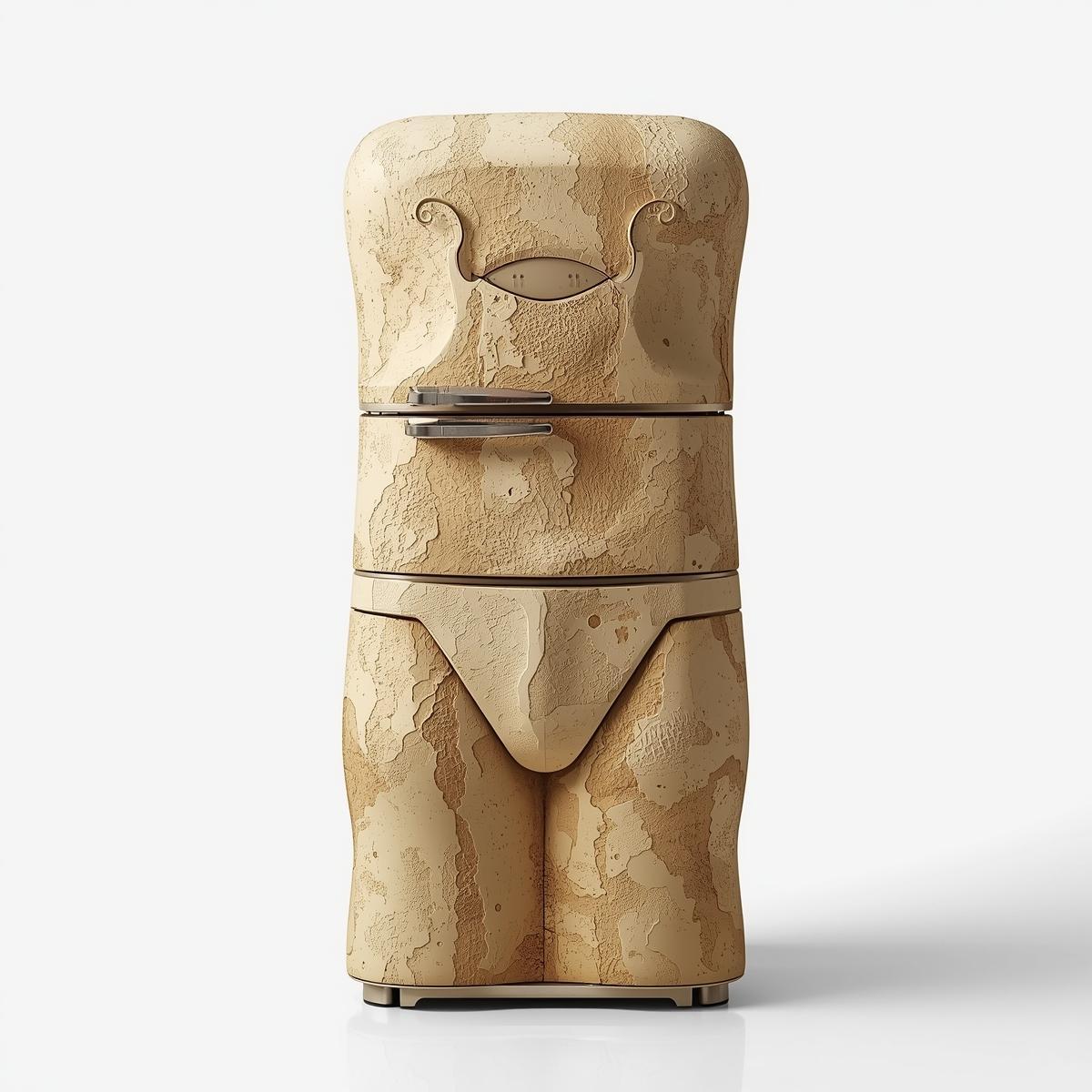
Mutanda refrigerator
"The Ascension of the Underwear Dreams"Critical and Semantic Analysis of the Work by Fanty Building
This painting is a powerful visual manifesto that encapsulates the artistic philosophy of Globism, founded by Fanty Building (Enrico Thanhoffer Munico), proposing a radical and playful alternative to the contemporary urban landscape.
1. The Aesthetic of Hyper-Saturation and the Dream"The Ascension of the Underwear Dreams" is distinguished by an aesthetic that transcends reality, immersing itself in a vibrant, dreamlike realm.
Colors and Atmosphere: The palette is intensely saturated (acid greens, earthy reds, golden skies), creating a feeling of hyper-real joy or benevolent hallucination. The atmosphere is not nostalgic but projected into a possible utopia where the light is always on for fantasy.
Dynamic Composition: The scene is balanced between the dense, floral foreground (bicycle and car) and the vertical background dominated by the towers. The diagonal line of the path and the ascent of the hot air balloon create a movement upward and forward, suggesting a path, a journey, or indeed, an ascension.
Globism is the conceptual core of the work, a genuine declaration against the homogenization and standardization of modern life.
Alternative Reality: The work serves as a portal to an interior, fantastical "globe." It is a mental architecture made physical, where the logic of the dream surpasses functionality. The goal is to reaffirm expressive freedom and the centrality of the individual in the face of industrial serialization.
Harmony Man-Nature-Artifice: Globism proposes a peaceful coexistence. Nature (meadows, flowers) is not relegated to artificial parks but invades and merges with the urban artifice. The architectural structures, in turn, are not machines but seem like organisms growing from the soil.
These buildings are the structural element and the most powerful symbol in the work.
Critique of Architecture: The rounded, sinuous forms and the chaotic stacking represent an ironic and decisive protest against the anonymity of modern concrete boxes. The artist challenges the "dictatorship of the rectangle."
The Metaphor of Intimacy: The allusion to anatomical and domestic forms suggests that architecture must be "dressed," intimate, and personal. The buildings are not cold shells but extensions of the individual, loaded with emotion and history, just as the name suggests a call to domestic and corporeal intimacy.
Construction of Dreams: The irregular, dreamy towers are the materialization of thoughts and desires raised towards the sky. They constitute the solid, albeit fantastic, foundation upon which the entire utopia rests.
The title "The Ascension of the Underwear Dreams" finds its references in movement and transport.
The Hot Air Balloon (Ascension): Placed high up, colourful, and in motion, it is the symbol of poetic escape and the achievement of a superior, detached, and philosophical perspective on life. It represents the elevation of spirit and fantasy (the "Dreams") above earthly triviality.
Humanized Travel: The bicycle and the decorated vintage cars sharply contrast with the speed and aggression of modern transport. They are emblems of "slow time" and travel as a contemplative and joyful experience, in harmony with the surrounding environment.
Artist: Fanty Building (Enrico Thanhoffer Munico)
1. ???? Formal Aspects and MaterialityTexture and Form: The object, a refrigerator, is treated with a texture that mimics sandstone, terracotta, or rough travertine. This gives the traditionally smooth, metallic object an ancient, organic, and tactile appearance, like a monolithic idol or a Moai statue, contrasting modern functionalism with historical sculptural gravity.
Design Reworked: The design is segmented into sections that deliberately imitate the human body.
Anthropomorphism and Irony: The appliance is transformed into a human figure. The lower section features a clear 'V' or triangular element, a direct, ironic reference to the "Mutanda Buildings" concept. Fanty Building uses this form to infuse intimacy, humanity, and irony into objects that would otherwise be cold and anonymous.
The Domestic Idol: By transforming the refrigerator into a statue, the artist elevates its status from a mere machine to a totemic entity presiding over domestic life, commenting on our quasi-religious relationship with consumption and food preservation.
Function Clothed: The artist rejects the idea that form must only follow function. Here, the function (refrigeration) is "clothed" with an emotional, historical, and ironic identity.
Warmth vs. Cold: The object, which must be cold by nature, is covered in a warm, organic material. This contrast symbolizes the need to humanize technology and infuse emotional warmth into the modern domestic environment.
Informazioni generali
-
Categoria: Architettura
Informazioni sulla vendita
- Disponibile: no
Informazioni Gigarte.com
- Codice GA: GA235808
- Archiviata il: 11/12/2025
Hai bisogno di informazioni?
Vuoi chiedere maggiori informazioni sull'opera? Vuoi conoscere il prezzo o fare una proposta di acquisto? Lasciami un messaggio, risponderò al più presto