Fanty Building: Beyond the Historical Shell
From "Globism" to Spheropolis: The Bio-Digital Metamorphosis of an Icon
By Architecture Today Editorial Staff
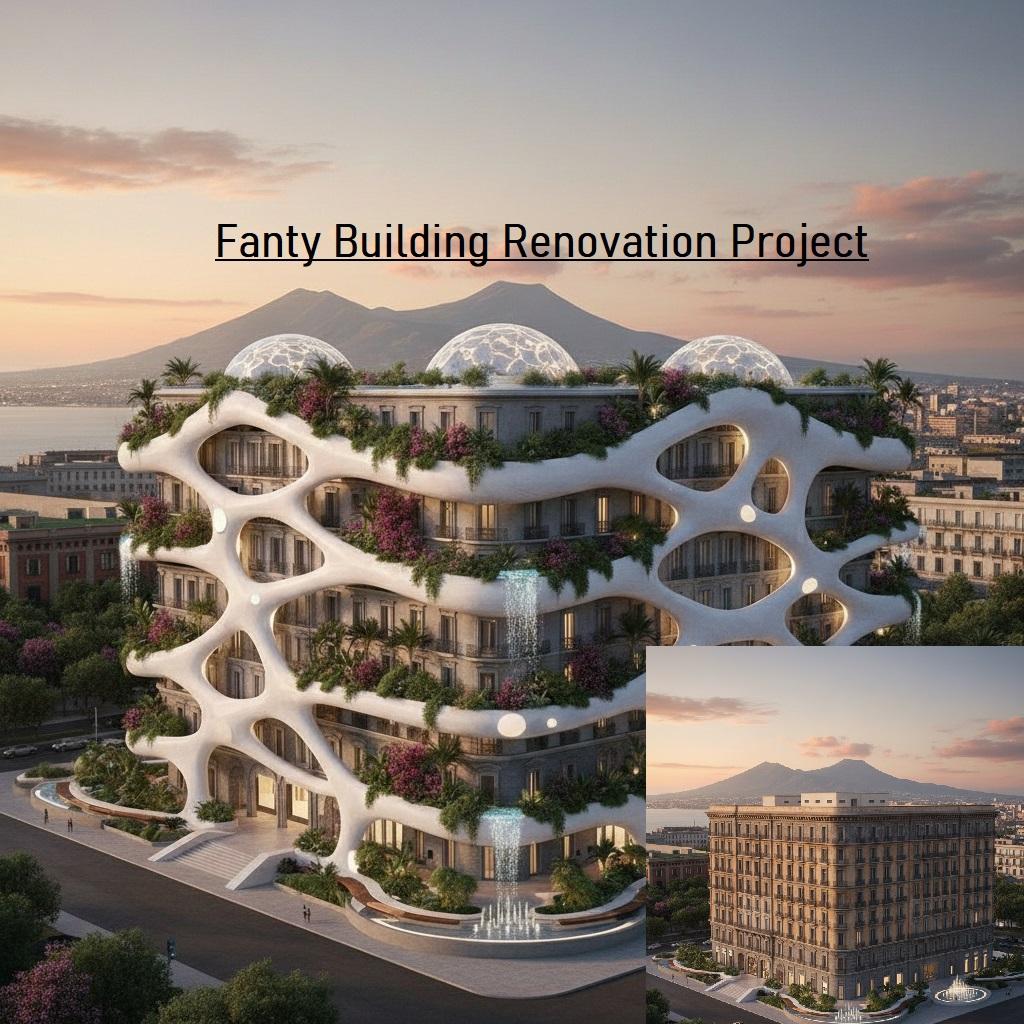
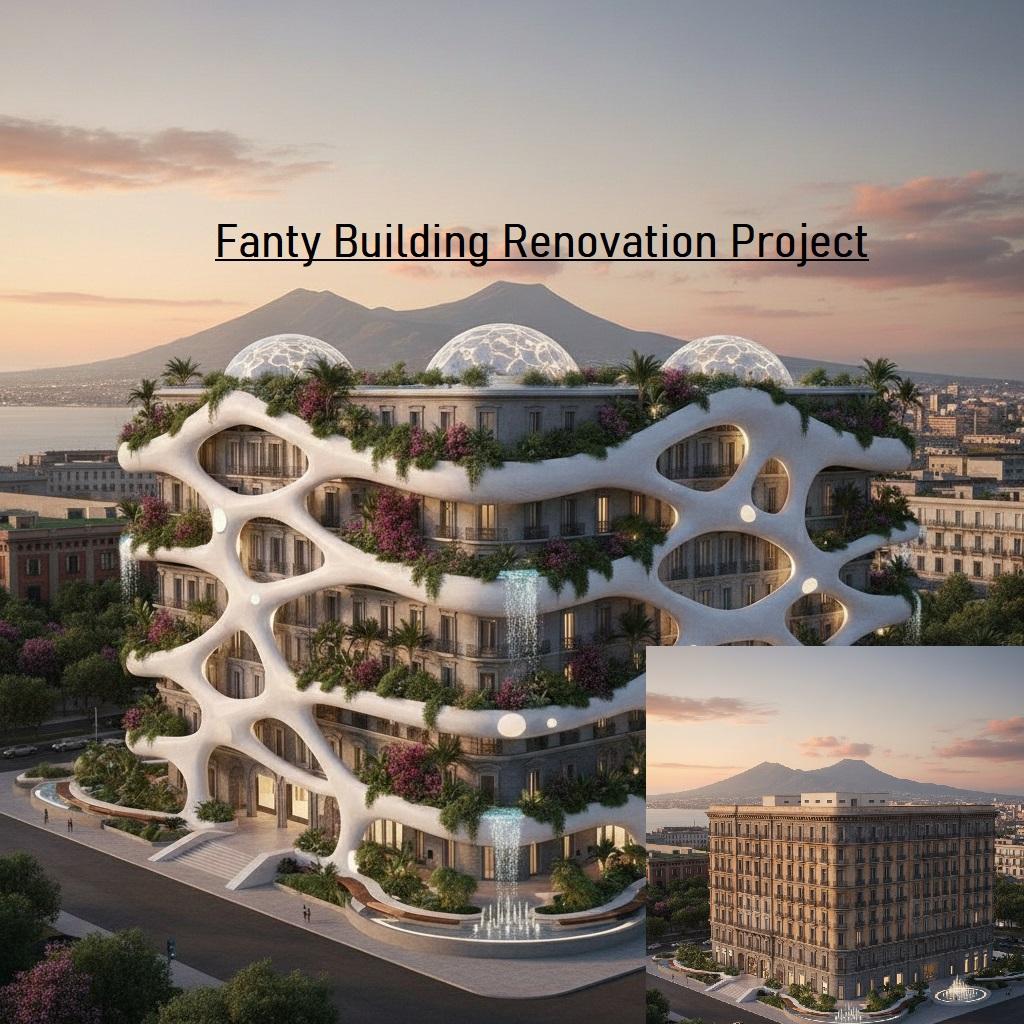
The intervention on the Fanty Building is neither a simple renovation nor a conservative restoration. It is a physical manifesto of a movement critics are beginning to define as Architectural Globism, where form no longer follows just function, but the global and organic expansion of a living system. The building sheds its 19th-century rigidity to don what is provocatively known in the industry as a "Mutanda Building" (Undergarment Building): a kinetic exoskeleton that wraps, protects, and regenerates the existing structure.
The Rise of SpheropolisThe project embraces the concept of Spheropolis, an urban utopia where spherical geometry and geodesic domes become the fundamental units of living. The three large translucent domes atop the Fanty Building are not merely ornamental; they represent controlled micro-ecosystems—biosphere bubbles that break the traditional skyline. In Spheropolis, the rooftop is no longer a closure, but an opening toward the cosmos, acting as a laboratory for protected urban agriculture and "under-glass" social interaction.
The Technology Behind the "Skin" (The Undergarment Effect)The term "Mutanda Building" describes, with technical irony, the grafting of a soft, flexible structure onto a rigid one. In this case, the white membrane enveloping the Fanty Building is a marvel of parametric engineering.
Smart Materials: The structure is crafted from fiber-reinforced composites (FRP) or high-performance biodynamic cement, capable of absorbing smog and self-cleaning through photocatalysis.
Closed-Loop Water Management: The spectacular waterfalls integrating the various levels are functional. They operate as a cascade heat exchange system, humidifying the air and reducing the temperature of the underlying glass surfaces by over $5°C$, drastically cutting summer cooling costs.
Sensor Integration: The exoskeleton is embedded with IoT sensors that monitor plant health and structural loads in real-time, rendering the building a "sentient organism."
While the central core remains anchored in history, the external technological "undergarment" propels the Fanty Building into the future. The use of topological optimization algorithms allowed for the creation of a mesh that, while appearing organic and random, distributes loads with extreme efficiency—reducing material usage by $30\%$ compared to traditional structures.
This intervention proves that Globism is not about uniformity, but about the capacity of architecture to expand and adapt like a cell within a larger tissue. The Fanty Building is no longer an isolated object, but an active node in a green, technological, and spherical urban network.
Informazioni generali
-
Categoria: Architettura
Informazioni sulla vendita
- Disponibile: no
Informazioni Gigarte.com
- Codice GA: GA238144
- Archiviata il: 14/01/2026
Hai bisogno di informazioni?
Vuoi chiedere maggiori informazioni sull'opera? Vuoi conoscere il prezzo o fare una proposta di acquisto? Lasciami un messaggio, risponderò al più presto